

How It Works | On the Rim

We turn on the tap to fill the iguana’s water bowl, and out comes the water. For Arizona Water Company customers in the White Mountains, that water comes from local wells. So how does a tank buried in Sedona figure into the bill for your iguana’s drinking water?
It sounds like a clerical error. But who owns the wells, tanks, and pipes that bring water to your tap? Around here, the answer depends on your address. Show Low operates its own water system and sets its water rates. Around Pinetop-Lakeside, some households buy water from a private company whose rates need state approval. Others get water from a public district with a local board that sets its rates. You might even see DWID on your bill.
What’s a DWID? What’s a political subdivision? We’ll get to it.
First, Sedona. Arizona Water and the City of Sedona asked the Arizona Corporation Commission to let the company share the full cost of the tank with customers as far away as Lakeside and Pinetop Lakes.
Arizona Water Company is a privately owned, for-profit utility serving communities across the state. The Arizona Corporation Commission’s five members are elected statewide. They regulate Arizona Water’s rates. Arizona Water can spread some of the costs of operating and improving its water systems among customers in several communities through a regional rate schedule. Lakeside, Pinetop Lakes, Overgaard, and Sedona are among the communities in what the company calls its Northern Group. Who owns the shares is a question for another story.
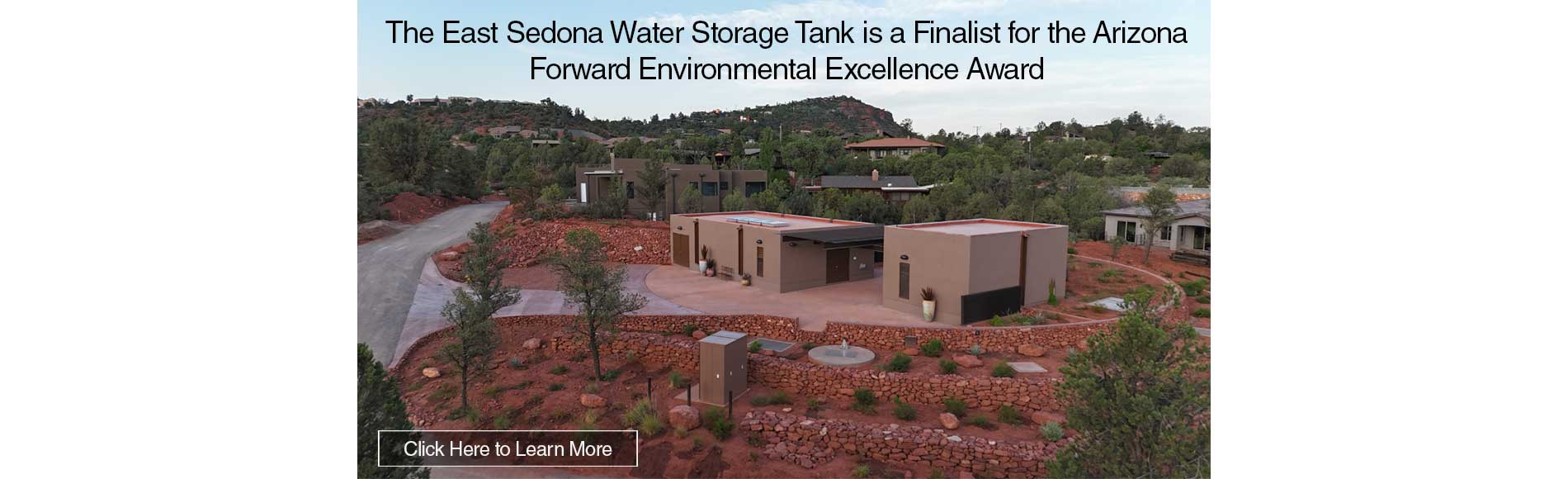
When Arizona Water applied for new rates in 2024, it included the cost of a tank and pumping station in East Sedona. The project was completed in March 2025 at a cost of about $20 million.
The tank holds 1.5 million gallons. The City of Sedona and Arizona Water say that before it was built, all of Sedona’s storage tanks were on the west side. Firefighters on the higher ground east of town depended on water stored two to three miles away. The new tank and pumps let crews draw on water stored on their side of town. According to the commission, the company agreed to bury the tank and design the buildings above it to resemble homes in response to requests from the city and nearby residents concerned about its appearance.
Burying the tank cost more than building it above ground. Should customers across the Northern Group share that extra cost, or should Sedona customers cover it? The city and the company proposed sharing the entire project cost across the group’s more than 21,000 customer connections.
While the commission agreed the storage tank was a necessary investment, on July 24, 2025, commissioners decided that only Sedona customers should pay the additional $6.058 million attributed to the underground design and related requirements. That left roughly $14 million of the $20 million project cost to be shared by the entire Northern Group, including Sedona.
That means Arizona Water customers in Lakeside and Pinetop Lakes help pay for a tank in Sedona through their rates. The Sedona City Council later suspended the city’s franchise fee on Arizona Water bills in Sedona, effective December 1, 2025, to ease the increase.
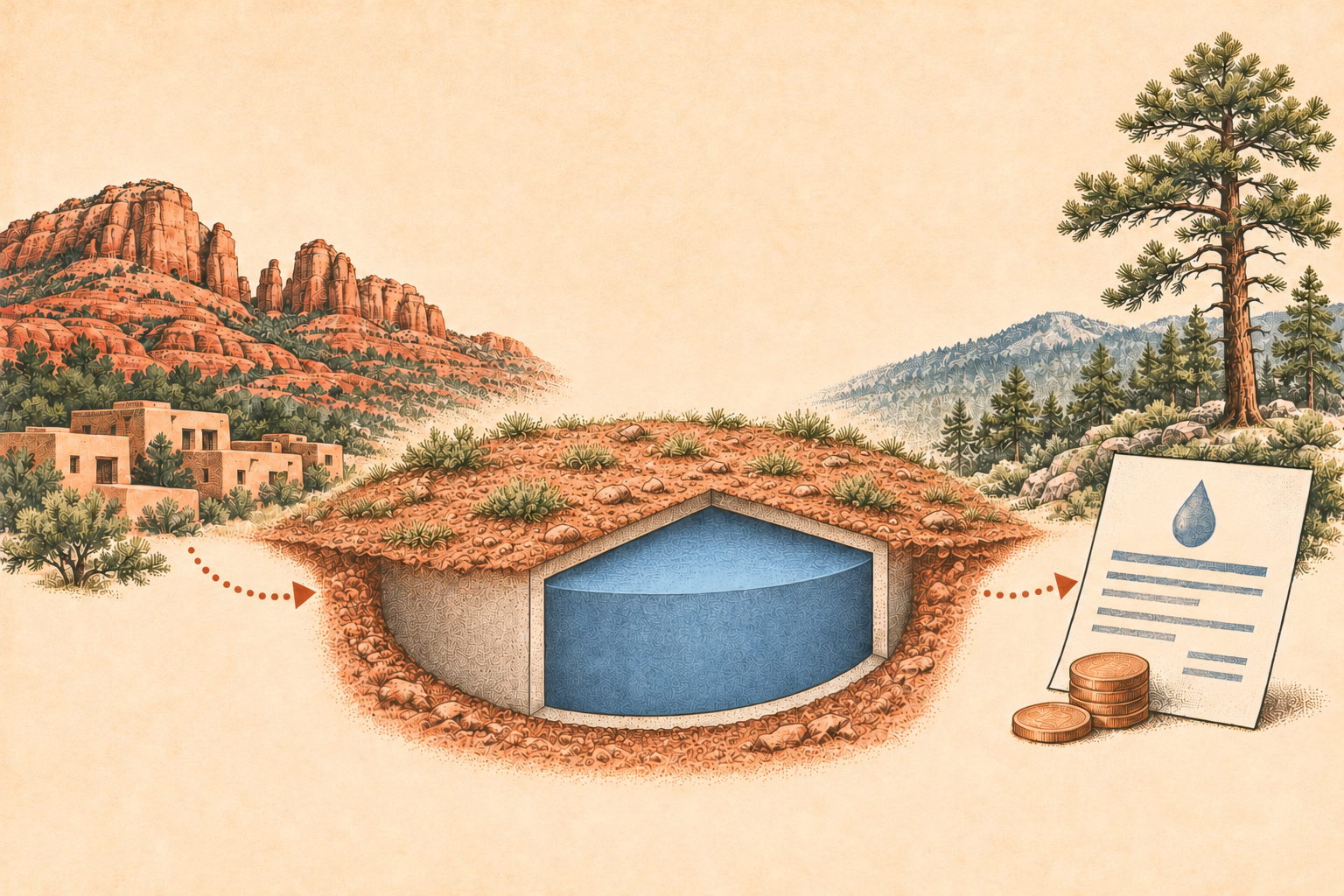
AI-generated conceptual illustration | On the Rim
What does that look like on a Lakeside bill?
When the new Northern Group rates took effect in August 2025, Arizona Water’s notice to customers showed what the increase would mean for a typical household with a standard residential water meter using 4,265 gallons in a month. Its bill would go from $39.92 to $52.42. That household would pay $12.50 more a month under the new rates. The notice doesn’t say how much of that increase comes from the Sedona tank.
The Lakeside rate sheet shows how that bill is calculated. The monthly minimum for that meter is $27.27. The first 2,000 gallons cost $4.8638 per thousand, and the next 2,265 cost $6.8093 per thousand. Add the water usage charges to the monthly minimum and the total comes to $52.42. Presumably the iguana had some help getting through those 4,265 gallons.
The 2025 example excludes surcharges and credits, so a current bill may include additional charges. For example, a separate rate schedule effective September 1, 2026, lists a $2.03 charge for the company’s customer information system on a meter of that size.
How does a construction project become part of a rate?
A storage tank can serve customers for decades. Arizona Water can ask to recover its investment over time through the rates it charges while that tank is in service. That brings two questions before the commission. How much of the investment should count when setting rates? What return should the company have the opportunity to earn on that investment?
When Arizona Water wants to change its rates, it submits a request called a rate case. Commission staff review the financial information, interested parties can present evidence, and the commissioners ultimately decide which rates to approve.
The commission considers what it costs to run the water systems and the value of the property used to provide water service. The approved rates are designed to cover operating expenses, recover eligible investments over time, and give the company an opportunity to earn a reasonable return on its investment.
That’s how the cost of the Sedona tank makes its way onto an Arizona Water bill here in the White Mountains. The same question has a different answer a few streets over if another provider serves your address.
What if a different name is on your water bill?
And without further ado, here’s your DWID, plus its cousin, the CFD.
Arizona Water serves Lakeside and parts of Pinetop Lakes. The town of Pinetop-Lakeside’s community services guide lists three public water districts serving the area. Pinetop Water is a community facilities district. Ponderosa and Wonderland Acres are domestic water improvement districts (DWIDs).
All three districts are political subdivisions. Each is a local government with a specific job and a boundary.
Pinetop Water Community Facilities District falls under a set of laws that allow a community facilities district, or CFD, to finance and operate public infrastructure. For drinking water customers, its district board governs the system and establishes its rates.
Another set of laws governs Ponderosa Domestic Water Improvement District and Wonderland Acres Domestic Water Improvement District. A DWID is a type of county improvement district formed specifically to provide or improve water service within defined boundaries. The district board sets water fees following a public hearing.
Who governs the system matters when a district needs to replace a pump or add storage. A district customer can take questions about the cost and its effect on rates to the local board. For Arizona Water customers, the public decision about rates takes place at the Corporation Commission, the same place the Sedona question was settled.
Why so many providers?
Some of the water systems are older than the town. For example, in 1973, state water records identified Ponderosa Water Company as the provider for the proposed Pinetop Country Club Village subdivision. That same year, Arizona Water already served customers in its Pinetop Lakes–Lakeside service area. Pinetop and Lakeside incorporated as one town in 1984. The water systems continued to serve their own areas. When the town formed the Pinetop Water Community Facilities District, it gave the district a specific job: to acquire and operate the existing Pinetop Water Company system. Today, the name on a water bill still reflects which system reached that neighborhood.
Who oversees the water itself?
The U.S. Environmental Protection Agency sets national drinking water standards. The Arizona Department of Environmental Quality (ADEQ) oversees testing and enforces those standards for the public water systems discussed here. For a proposed subdivision, the Arizona Department of Water Resources looks at another question: will enough water be available to serve it over the next 100 years?
Local governments also have a role when a district is created. The town formed Pinetop Water as a community facilities district. For a domestic water improvement district, landowners petition the county, and the county board of supervisors decides whether to establish the district. Once established, the district board handles water fees.
Where can I take a question about my service?
Start with the provider on your bill. If your bill says “Pinetop Water,” the district office can answer questions about your charges. If you’re moving or your landlord pays for water, find your neighborhood on the state’s water service map, then ask the provider to confirm your street address.
City of Show Low water customers can check the City Council agenda for rate proposals. Regular meetings are the first and third Tuesdays at 7 p.m. For Pinetop Water, check the district’s posted agendas or call 928-367-2022 to confirm the next meeting. Wonderland Acres posts meeting notices and agendas on its Board Meetings page. For Ponderosa, call the district at 928-369-3342 and ask when the board meets next and where the agenda is posted.
Arizona’s Open Meeting Law generally requires city councils and district boards to give at least 24 hours’ notice of a public meeting and make an agenda available. Look for a proposed fee or rate hearing on that agenda. It tells you when the board will take up the question.
When can those rates change again?
For Arizona Water customers, another rate decision is approaching. The company is asking the commission to allow it to adjust Northern Group rates annually for five years using a formula tied to changes in the cost of providing water. The company says the plan would reduce the delay between a change in its costs and a change in rates. The commission still has to decide whether to approve the proposal and how the formula would account for the company’s expenses and return on investment.
Telephone comments begin January 6, 2027, at 5:30 p.m., with additional sessions February 2 at 10 a.m., February 8 at 5:30 p.m., and February 18 at 10 a.m. The hearing to take evidence begins March 15, 2027, at 10 a.m. in Tucson, with another opportunity for public comment at the start. All times are Arizona time. To comment by phone, call 1-877-309-3457 and enter 24601833204##.
You can also file a written comment. Include both docket numbers so your comment reaches the combined hearing. W-01445A-24-0117 is the 2024 Northern Group rate case. Arizona Water filed its annual adjustment proposal for local customers in the second phase of that same case. W-01445A-26-0044 is the 2026 Eastern and Western Groups rate case. The commission joined the proceedings to consider the proposed formula for all three groups together.
For a question about the gallons or charges on your own Arizona Water bill, contact the Lakeside office.
The same commission that decided how to divide the cost of Sedona’s tank will decide whether Arizona Water can adjust its rates each year. If Ponderosa needs a new tank, its customers can take that question to their district board. Who decides? The answer depends on which name is on your bill.
That’s the lay of the land. There are plenty of rabbit holes left to explore. How did your neighborhood end up with the water system it has? If you dig into that one, we’d like to hear what you find. Send your take to editor@readtherim.com.
How It Works is an On the Rim series about the systems we rely on, who makes the decisions, and how residents can have a say.